
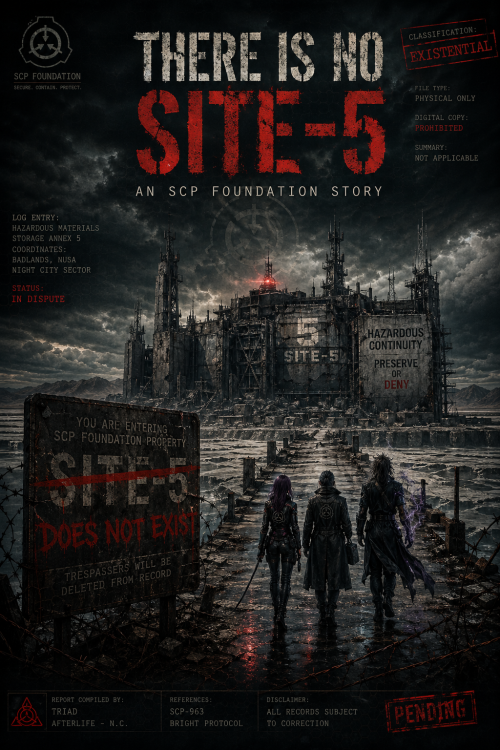
 <font 26px/inherit;;inherit;;inherit>ACE & MAI — “THERE IS NO SITE-5” ACT 1 — BADLANDS REPORT</font>
The first problem was the salt.
Badlands crews knew dust. They knew rust, burned rubber, old blood baked into sand, leaked coolant, dead battery acid, sun-split concrete, and the particular metallic taste that rose from the earth after a drone strike had cooked something expensive underground.
They did not know saltwater.
Not out there.
Not thirty-seven kilometers beyond the last honest utility pole, where the world outside Night City flattened into scrubland, half-buried industrial scrap, wind-polished wrecks, and abandoned dreams that had once come with corpo financing.
Rafa Mendez noticed it first because the left rear tire of his rig kept hissing.
Not punctured. Not fully.
Just hissing.
Softly.
Like the tire was trying to remember the ocean.
He stopped the rig on the edge of a dried basin that none of his maps admitted existed and stepped out with a flashlight in one hand and a pistol in the other. The pistol came first by habit. The flashlight came second because Badlands darkness did not respect optimism.
The ground crunched under his boot.
White crust.
Rafa crouched, touched two fingers to it, and brought them to his tongue before his brain finished telling him that was a stupid thing to do.
Salt.
Real salt.
“Problem?” asked Mara from the passenger seat.
Rafa looked at the basin.
The dust storm had passed less than an hour ago, rolling east in a brown wall that had swallowed their route, killed their drone feed, and forced them to park blind under the skeleton of an old power relay. When it cleared, the horizon had changed.
There was a structure in the basin now.
Not a small one.
A black, broken mass half-submerged in salt-crusted earth, its outer walls curved like the hull of something that had once expected water around it. Towers rose from it at uneven angles. Walkways hung snapped and rusted. Antenna spines reached into the night with the brittle posture of dead insects.
It looked like a man-made island.
It looked impossible.
It looked expensive enough that someone should have shot them before they saw it.
Rafa spat salt into the dirt.
“Yeah,” he said. “Problem.”
Mara climbed down from the cab, saw the thing, and stopped complaining mid-breath.
That was how Rafa knew the problem had gotten worse.
Behind them, the third member of the crew, a skinny kid called Nix who was old enough to steal engines and young enough to believe that made him immortal, whistled.
“What the hell is that?”
Rafa did not answer.
The basin wind moved across the salt flats with a dry whisper, carrying a smell that did not belong to the Badlands. Brine. Wet metal. Old sea growth. Rot sealed too long and opened by accident.
Mara lifted her scanner.
The screen blinked.
Mapped terrain.
Then industrial exclusion zone.
Then open desert.
Then the scanner restarted.
Mara stared at it.
“That’s new.”
“What?”
“It says we’re not here.”
Rafa looked back at the structure.
A faint light flickered inside one of the broken towers.
Not bright.
Not welcoming.
Just enough to prove the dark had infrastructure.
Nix grinned.
“We should check it out.”
Rafa and Mara both looked at him.
The kid’s grin faltered.
“What? Salvage.”
Rafa pointed at the basin.
“That thing is bigger than a block in Santo. It appeared after a dust storm. It smells like ocean in the middle of dry dirt. Your scanner just had a personal crisis. So no, genius, we are not checking it out.”
Nix looked at the structure again.
His grin came back smaller and worse.
“Then we sell the location.”
Mara’s scanner blinked again.
The structure vanished from the display.
But not from the world.
Rafa stared at the blank map, then at the ruin, then back at the map.
“Try the drone.”
Nix launched the drone from the rig’s roof with the solemn joy of a boy who had never properly respected consequences.
The drone rose ten meters.
Twenty.
Thirty.
Its camera feed showed the basin. Salt flats. The broken structure. A rusted outer sign near what might have been a loading causeway.
Then the feed smeared.
Static rolled across the screen.
The structure disappeared.
The camera showed empty desert.
Nix swore and tilted the drone downward.
Empty desert.
But in front of them, physical and patient and far too large to be a hallucination, the ruin remained.
Mara lowered the scanner slowly.
“Nope,” she said.
Rafa nodded. “Yep.”
Nix looked between them. “So we leave?”
Rafa turned back toward the rig.
“We leave.”
That was when the wind shifted.
Something metallic screeched inside the basin. Not loud enough to be close. Loud enough to be heard.
A hanging sheet of metal tore free from the ruin and slid down the outer wall in a long, slow fall. It hit the salt flat with a sound like a church bell dropped into a grave.
Rafa flinched.
Nix, because the universe enjoyed punishing predictability, ran toward it.
“Nix!”
The kid ignored him.
Mara cursed and followed.
Rafa considered letting natural selection handle the matter.
Then he remembered Nix owed him money.
“Damn it.”
They reached the fallen metal five minutes later.
Up close, the ruin was worse.
The outer wall was covered in layers of corrosion, old paint, mineral streaks, and barnacle-like growths that had no business surviving a desert. Pipes jutted from the lower hull like broken ribs. A massive door sat sealed under three meters of caked salt and sand, marked with hazard symbols that looked almost familiar until you tried to focus on them.
The fallen panel lay face down.
Nix got one hand under the edge and pulled.
It did not move.
Mara helped.
Rafa helped last, muttering every curse he knew and inventing two more for the occasion.
The panel rolled over.
Their flashlights caught the lettering.
Faded.
Rusted.
But legible.
SITE-5 SCP FOUNDATION
For a moment, nobody said anything.
Then the letters flickered.
Not the panel. Not light. Not reflection.
The letters themselves seemed to hesitate.
Mara stepped back.
The lower line blurred, not visually but cognitively, like her mind was trying to make it mean something safer.
SUBSURFACE CONTAINMENT PROJECT
She blinked.
It was SCP FOUNDATION again.
Nix whispered, “Did you see that?”
Rafa drew his pistol fully.
Against a metal sign, the gesture was useless.
It helped anyway.
Mara lifted her scanner and took a still image.
The scanner displayed:
NO OBJECT DETECTED.
Then:
CHEMICAL STORAGE ANNEX FRAGMENT.
Then:
IMAGE CORRUPTED.
Then the device powered down.
Rafa looked at the sign.
The sign looked back in the way dead objects sometimes did when the world around them was lying.
“Take it,” he said.
Mara stared at him.
“You just said leave.”
“I said leave before the sign started rewriting itself.”
“That is not an argument for taking it.”
“It is if we want anyone to believe us.”
Nix swallowed.
“Who do we sell it to?”
Rafa looked toward the ruin.
A door somewhere inside groaned.
Not opening.
Remembering opening.
Rafa stepped back.
“Someone expensive.”
By morning, Rafa no longer remembered finding the structure.
He remembered stopping because of a tire problem.
He remembered salt on the ground, but not why that mattered.
He remembered Nix cutting his hand on metal. Mara yelling. The drive back. The rig’s rear tires leaving wet tracks across dry road.
Wet tracks.
That was wrong.
He sat in a Badlands broker’s shack with a cup of coffee that tasted like battery runoff and watched Mara argue with herself over a piece of paper.
Not with him.
With herself.
The broker, a thick-necked woman called Sable who bought information the way other people bought ammunition, watched both of them with increasing irritation.
“You said you had something,” Sable said.
Rafa looked at Mara.
Mara looked at the paper.
On it, in her own handwriting, were three lines:
FOUNDATION SITE. NOT ON MAPS. DO NOT LET THIS BECOME ONLY DIGITAL.
Under that, added in different pressure but the same hand:
There is no Site-5.
Mara stared at the last line.
“I didn’t write that.”
Sable leaned back.
“Everyone says that about the interesting parts.”
Mara slammed the metal sign fragment onto the table.
Dust jumped.
The shack went quiet.
Even the old generator outside seemed to cough lower.
Sable looked at the fragment.
The letters were still there.
Not clean. Not stable.
But there.
SITE-5 SCP FOUNDATION
For three seconds, everyone remembered.
The basin. The salt. The ruin.
Then Sable’s eyes narrowed.
“What the hell is SCP Foundation?”
Rafa opened his mouth.
Nothing came out.
He knew he had asked that question.
He knew he had gotten no answer.
He knew the answer mattered.
Mara touched the sign with two fingers.
The lower line crawled.
SCP FOUNDATION
Then:
SECURE CONTAINMENT PROCEDURE
Then:
STRUCTURAL CORROSION PLATE
Then back.
Sable stopped leaning back.
Good sign, Rafa thought.
Bad sign, also.
Sable did not scare easily. People who brokered Badlands information survived by distinguishing between “profitable strange” and “leave it in the dirt strange.”
Her face said this had just crossed the border.
She reached for an old analog camera on a shelf.
Not a scanner.
Not optics.
Old glass, old film, old mechanical shutter.
Rafa had never liked Sable more.
She took a photograph.
The camera clicked.
The sign did not change.
Sable smiled without warmth.
“Now,” she said, “this is expensive.”
Rogue heard about the sign before noon.
Not because Sable trusted her.
Trust was a word people used when they wanted better prices.
Rogue heard about the sign because Sable was smart enough to know when information had stopped being merchandise and started being liability.
The message arrived through three human mouths and one physical envelope.
That alone made Rogue interested.
The Afterlife was not busy yet. It was too early for the serious ghosts and too late for the desperate ones who had survived the previous night and still believed they had leverage. A few mercs occupied the edges of the room, drinking with the posture of people waiting for either money or regret. The club lights kept the place in permanent artificial dusk.
Rogue sat in her booth with the envelope on the table.
She had not opened it.
Not digitally. Not scanned. Not fed through any device.
The envelope was old paper, sealed badly, and smelled faintly of salt.
That was enough to annoy her.
She looked at the bartender.
“Call them.”
He did not ask who.
People who worked for Rogue survived by understanding pronouns.
Ace disliked being summoned before food.
Technically she disliked being summoned at all, but food sharpened the principle.
She entered the Afterlife first, small, black-haired, violet-eyed, and carrying enough compact displeasure that two mercs near the bar unconsciously shifted their chairs without knowing why. Her uneven hair caught a faint purple sheen under the club lights. The hilts of her katanas rode at her back with the quiet confidence of tools that did not require advertising.
Mai followed, silver hair tied back in a messy ponytail, eyes already scanning the room. She looked calm in the way structural supports looked calm. Not relaxed. Load-bearing.
Shammy came last, tall enough that the club’s ceiling lights seemed to acknowledge her in passing. Silver-white hair with faint electric-blue shifts moved slightly in air that had not touched anyone else. Her presence did not demand attention. It changed the pressure until attention rebalanced around her.
Rogue watched them approach.
“Morning,” Ace said.
“It’s afternoon.”
“Then someone stole my morning.”
Rogue pushed the envelope forward.
“Badlands.”
Mai sat before Ace could decide whether to remain standing out of principle.
That settled it.
Ace sat.
Shammy slid into the booth with a mild glance at the envelope.
Her expression changed by almost nothing.
Rogue caught it.
“Already?”
Shammy looked at the paper.
“It smells like something trying not to be remembered.”
Ace leaned away from the envelope by half an inch.
“I hate when the job starts before the job starts.”
Mai opened the envelope carefully.
Inside were three things.
A photograph.
A handwritten report.
A flake of rusted metal sealed in clear plastic.
Mai looked at the photograph first.
The image was grainy, analog, imperfect.
But there it was.
A corroded sign fragment on a rough table.
SITE-5 SCP FOUNDATION
Ace’s posture changed.
Not much.
Enough.
Rogue looked from Ace to Mai.
“You know it.”
Mai did not answer immediately.
Ace did.
“We know the second line.”
Rogue’s eyes sharpened.
“Foundation.”
Mai looked at the handwritten report.
Her pupils moved once, twice, then stopped.
“What?”
Mai turned the page so Ace could see.
The handwriting described a Badlands ruin. A man-made island structure in a dry basin. Salt. Drone feed failure. Map contradiction. Physical signage.
At the bottom:
Personnel are to be reminded that there is no Site-5.
Ace read it twice.
“Is that a joke?”
Mai’s face said no.
Rogue leaned back.
“That line appeared after the broker photographed the sign.”
Mai looked up.
“Appeared.”
“That was the word used.”
“On paper?”
“On paper.”
Mai set the report down.
The table felt colder.
Shammy reached toward the rust flake but did not touch it.
Rogue noticed that too.
“Problem?”
“Yes,” Shammy said.
Ace looked at her.
Shammy’s eyes remained on the sealed flake.
“It is not calling. It is correcting the room for noticing it.”
Rogue’s expression hardened.
“That sounds expensive.”
“It is worse than expensive,” Mai said quietly. “It is administrative.”
Ace turned to her.
Mai tapped the line at the bottom of the paper.
“This is not denial as secrecy. This is denial as process.”
Rogue waited.
She had the patience of someone who had survived too many explanations and learned to charge interest on them.
Mai continued.
“If the Foundation wanted something hidden, there would be missing files, false names, access locks, dead witnesses.”
“Comforting list,” Ace muttered.
“This is different. The record is not being hidden. It is being corrected.”
Rogue looked at the photograph.
“The place exists.”
“Yes,” Ace said.
Mai glanced at her.
Ace shrugged.
“There is a picture. There is a sign. There is salt on the envelope. Someone cut their hand on it. That is existing.”
Mai did not argue.
That mattered.
Rogue looked back to Mai.
“And this correction can reach Night City?”
“We do not know.”
“That is not an answer I like.”
“It is the only honest one.”
Rogue’s mouth tightened.
Shammy finally pulled her hand back from the flake.
“The city would not notice quickly.”
All three looked at her.
She chose her words carefully.
“If this spreads, things would not disappear with drama. They would become easier to explain away.”
Ace went very still.
Mai’s eyes sharpened.
Rogue said nothing for a long moment.
Then:
“Explain.”
Shammy looked toward the club floor. The Afterlife breathed around them: glasses, low voices, a laugh from someone trying too hard, the hum of lights over old violence.
“A missing person becomes a bad registration. A sealed room becomes unused storage. A scream becomes faulty audio. A name becomes a clerical mistake.” She paused. “A city like this has many places for absence to hide.”
Rogue’s face became unreadable.
That meant she understood.
Night City was built from profitable absences. Missing bodies. Missing records. Missing guilt. Missing accountability. Whole towers balanced on the ability to make consequences look like paperwork.
A correction field would not need to conquer the city.
It would only need to make the city more itself.
Rogue slid the photograph closer to Mai.
“I want to know what that facility is.”
Mai nodded.
“I assumed.”
“I want to know whether it can touch my city.”
“Also assumed.”
“And if it can?”
Ace smiled thinly.
“Then we make touching difficult.”
Rogue looked at her.
“Cute.”
Ace’s smile widened by one degree.
“Accurate.”
Mai picked up the rust flake packet and held it to the light without opening it.
The flake shifted inside.
Not physically.
Its label did.
The small handwritten tag from Sable read:
SIGN FRAGMENT — SITE-5
Then:
SIGN FRAGMENT — INDUSTRIAL ANNEX
Then:
CORROSION SAMPLE — NO SITE ORIGIN
Mai’s hand froze.
Ace saw it.
Rogue saw Ace see it.
Shammy’s hair lifted faintly at the ends.
Mai turned the packet over.
On the back, where there had been no writing, a line appeared in thin black ink.
There is no Site-5.
Ace stood.
The motion made two nearby conversations die instantly.
Mai did not stop her.
Rogue looked at the packet, then at Ace.
“Taking the job?”
Ace’s voice was quiet.
“No.”
Rogue’s brow moved a fraction.
Ace looked at the words on the plastic.
“We’re taking the argument.”
For the first time that afternoon, Rogue smiled.
Not warmly.
Correctly.
“Good. Arguments are cheaper to bury than cities.”
Mai placed the packet back in the envelope and folded it shut.
“Do not copy this digitally.”
Rogue gave her a look.
“I survived before you were born.”
Mai did not blink.
“And yet.”
Rogue laughed once.
Sharp. Brief. Real.
Then she reached under the table and produced a second envelope.
Ace stared.
“You had another one.”
“I had the original.”
Mai’s eyes narrowed.
Rogue placed it on the table.
“This is the copy.”
No one touched it.
Rogue leaned forward.
“Tell me what I need to know before you leave.”
Mai looked at the original envelope.
Then at the copy.
Then at Rogue.
“Keep them apart.”
Rogue’s expression changed.
That was not the advice she had expected.
Mai continued.
“If one corrects, compare it to the other. Do not let any one version become authoritative.”
Rogue’s fingers tapped once against the table.
“That sounds familiar.”
Ace looked at her.
Rogue’s eyes flicked toward the club screens, where some late-cycle commentary about Mr Fate still played without sound.
Mai nodded.
“It is the opposite problem with the same lesson.”
Mr Fate had made one voice out of many.
Site-5 was trying to make many proofs into none.
Rogue accepted that with a small nod.
“Go.”
Ace turned toward the exit.
Mai gathered the copy envelope.
Shammy stood last, still looking at the original.
Rogue noticed.
“What?”
Shammy’s voice was soft.
“The paper knows we are leaving.”
Rogue looked at the envelope.
Nothing moved.
Nothing changed.
That made it worse.
“Do I need to lock it up?”
Mai answered before Shammy could.
“Locking may not be enough.”
Rogue looked at her.
“What is enough?”
Mai’s mouth tightened.
“We are going to find out.”
The Badlands road out of Night City was not a road in any meaningful civic sense.
It was an agreement between tire marks, old concrete, and people who had learned where mines used to be.
Night City receded behind them in layers: towers first, then arterial lights, then the outer industrial sprawl, then the dirty glow of human concentration refusing to die quietly. By the time the last holo-ad dissolved behind dust, the world ahead had flattened into brown-gold desolation under a sky the color of old steel.
Ace sat in the back of the vehicle with one boot braced against the opposite seat, arms folded, eyes on the envelope between them.
Mai drove.
Not because Ace could not.
Because Mai wanted control over distance.
Shammy sat in the passenger seat with the window cracked, letting Badlands air move through the cabin. Her silver-white hair lifted and settled with small changes in pressure. Every now and then she tilted her head as if hearing something under the engine.
Ace finally said, “I preferred Mr Fate.”
Mai did not look away from the road.
“No, you did not.”
“It had screens. Screens can be broken.”
“Many screens were broken.”
“Exactly. Achievable.”
Shammy glanced back.
“This place may also have things to break.”
Ace looked at her.
“You say that like comfort.”
“I am practicing.”
Mai’s mouth curved despite herself.
Ace saw it in the rearview mirror and decided the day was not entirely lost.
Then the vehicle navigation pinged.
Route unavailable.
Mai tapped the display.
The route returned.
Then vanished.
Then returned as a route to a municipal landfill thirty kilometers west.
Mai shut the navigation off.
Ace leaned forward.
“Already?”
“Yes.”
“Good.”
Mai glanced at her through the mirror.
Ace shrugged.
“If it is already lying, we are close enough to annoy it.”
Shammy closed her eyes.
“The air has salt in it.”
Mai slowed.
The road ahead dipped toward a basin that should have been empty.
It was empty on the vehicle’s external scan.
It was empty on the passive terrain lidar.
It was empty on the old printed Badlands survey folded under Mai’s left hand.
But through the windshield, under a long smear of windblown dust and late sun, something enormous lay in the basin.
Broken towers.
Curved walls.
A dead island in a place where water had no right to remember itself.
Mai stopped the vehicle.
No one spoke.
The facility sat there in ruined silence.
Physical.
Patient.
Wrong.
Ace opened the door and stepped out.
The ground crunched white beneath her boots.
She crouched, touched the salt, and rubbed it between her fingers.
Mai came around the vehicle with a scanner in one hand and the analog photo in the other.
The scanner displayed open terrain.
The photo showed the sign fragment.
Shammy stood between them and the basin, eyes narrowed slightly, hair moving in wind that had not yet reached the others.
Ace looked at the structure.
“This exists.”
Mai watched her scanner blink.
Open terrain.
Industrial waste zone.
No mapped object.
Chemical storage.
Open terrain.
Then, for half a second:
SITE-5
Then:
NO SITE FOUND
Mai stared at the screen.
The words updated again.
Personnel are reminded that there is no Site-5.
Ace looked over her shoulder.
Mai did not move.
Shammy whispered, “It noticed the sentence.”
Ace stood.
In the basin below, a strip of exterior signage peeled loose from the ruined wall and fell soundlessly into salt dust.
Mai lowered the scanner.
Her voice was quiet.
“We are standing in a correction.”
Ace’s hand went to one katana.
“Then let’s be difficult to edit.”
They began walking down into the basin.
Behind them, the vehicle’s onboard log updated its destination.
Not Site-5.
Not the Badlands.
Not even the landfill.
It recorded:
ROUTINE WEATHER DELAY. NO ARRIVAL.
—
© 2025-2026. “World of Ace, Mai and Shammy” and all original characters, settings, story elements, and concepts are the intellectual property of the author. All rights reserved.
Non-commercial fan works are allowed with attribution.
Commercial use, redistribution, or adaptation requires explicit permission from the author.
Contact: editor at publication-x.com
Check out our SubscribeStar page at https://subscribestar.adult/konrad-k